
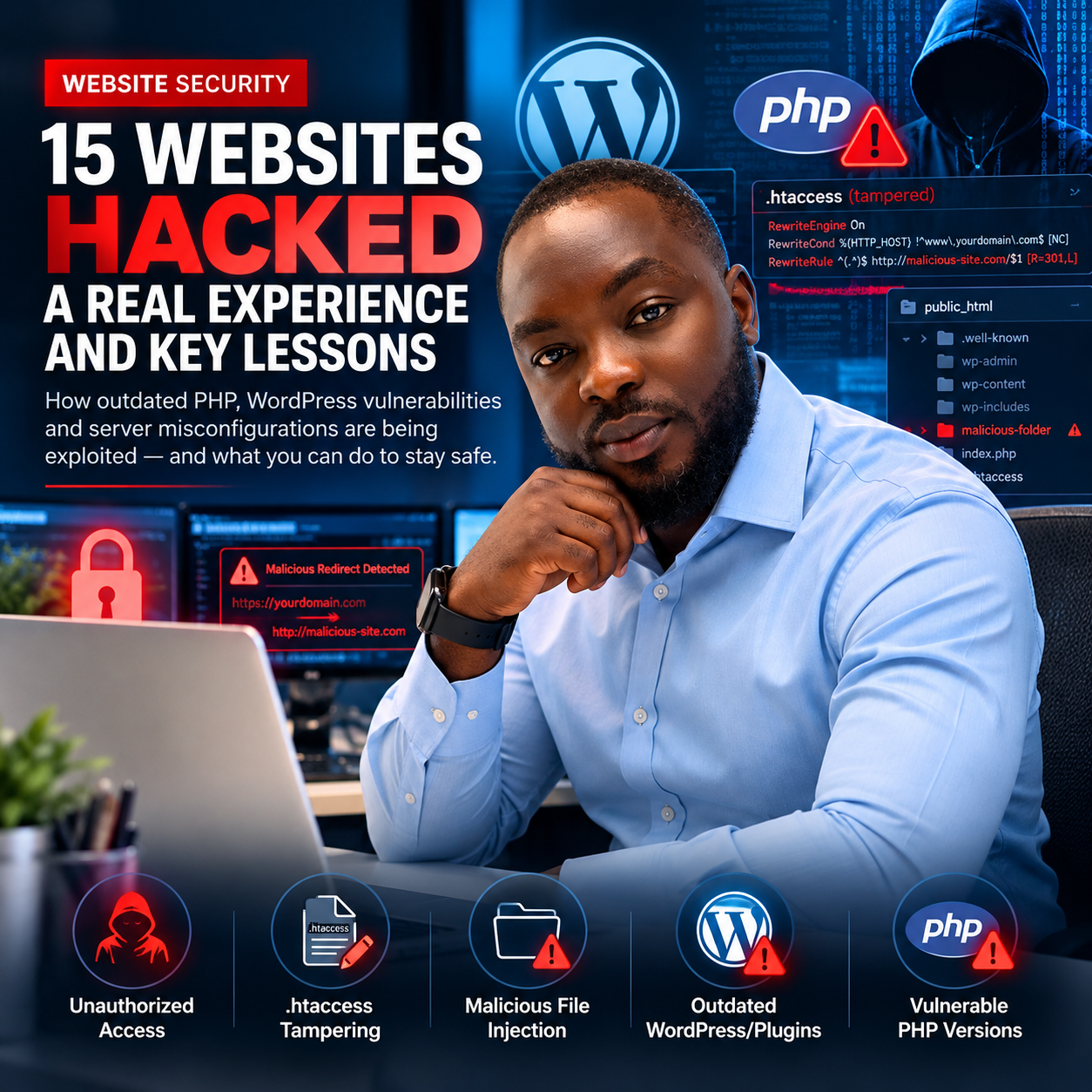
This past week, a major PHP security issue dominated industry conversations, reminding everyone that website security is not optional; it is a business necessity.
As someone who actively builds, manages, and supports digital platforms for clients, this hit close to home.
Recently, I had to deal with the compromise of about 15 PHP and WordPress websites. In many of those cases, clients were unaware of what had happened in the background. While they continued focusing on their businesses, I had to step in immediately to investigate, isolate the issues, restore the websites, and reinforce security across the affected projects.
That experience was a strong reminder that website management is not just about design, development, or deployment. It is also about responsibility, vigilance, and protecting business continuity.
What I encountered
The attacks were not random inconveniences. They were deliberate attempts to hijack business assets and abuse weaknesses in hosting environments and outdated software.
Some of the issues I found included the following:
- Tampering with
.htaccessfiles to redirect a website’s primary domain to suspicious or malicious destinations. - Injection of rogue folders and files inside the public directory to trigger unauthorized redirects and malicious page behaviour.
- Hidden backdoors and scripts designed to maintain persistence even after an initial cleanup.
- Exploitation of outdated PHP environments, WordPress core files, themes, or plugins.
These are the kinds of attacks that quietly damage business credibility. A hacked website is not just a technical issue—it is a trust issue.
Why this matters
When a business website is compromised, the damage goes beyond downtime.
It can affect:
- Brand integrity
- Customer trust
- Search visibility
- Lead generation
- Sales and conversions
- Operational confidence
For many small and growing businesses, their website is not just a digital brochure. It is their storefront, lead engine, communication hub, and reputation centre.
That is why unethical hacking is so destructive. It frustrates honest business owners and the professionals working hard to build and manage digital systems that keep those businesses alive.
The invisible work behind restoration
In situations like this, restoration often involves much more than simply bringing the website back online.
It means:
- Auditing compromised files and access points,
- Identifying and removing malicious scripts,
- Repairing server and configuration files,
- Cleaning infected directories,
- Resetting credentials and tightening permissions,
- Updating PHP, WordPress core, plugins, and themes,
- Introducing stronger security practices,
- and monitoring the website afterwards to prevent reinfection.
A lot of this work happens quietly, without the client fully seeing the weight of what was prevented.
But that is part of the responsibility.
My takeaway
The recent PHP vulnerability making headlines is another reminder that every business owner, agency, and web professional must take proactive security seriously.
Security should never be treated as an afterthought.
If you run WordPress or PHP-based websites, this is the time to:
- keep PHP versions updated,
- update WordPress core, themes, and plugins,
- audit unused plugins and remove abandoned tools,
- monitor file changes,
- strengthen hosting and access controls,
- and maintain regular backups and recovery plans.
Final thought
Building websites is one thing.
Protecting them is another level of responsibility.
As professionals, we owe it to our clients not just to build functional websites, but to build and maintain resilient, secure, and trustworthy digital systems.
The work can be demanding, and often invisible, but it matters.
If your business runs on WordPress or PHP, this is your reminder to review your security posture before the next issue becomes a crisis.
Written by George Obafemi Samuel
Managing Director / Chief Executive Officer
Slushtech Ltd.
Product & Technology Strategist | Web Development & Digital Security
